Roman mosaics, medieval strongholds and Atlantic ports reveal a Portugal best understood slowly. Follow its history across the mainland and islands, with time for the places and flavours between the monuments.
Begin in the north, where the country took shape
Portugal’s history is not arranged neatly behind museum glass. It sits beneath café tables, rises above vegetable gardens and sometimes interrupts the road. Begin in Braga, where Roman Bracara Augusta survives at the archaeological remains of the Alto da Cividade baths. Then look towards Guimarães, whose castle and medieval streets belong to the story of the kingdom that emerged in the twelfth century. These are different chapters, close enough to read together without rushing.
From Porto, allow roughly an hour by road to Braga, then 25 to 35 minutes to Guimarães. Give each town more than a photographic stop. In Guimarães, sit in Largo da Oliveira and notice how ordinary life continues around the church and old arcades. Lunch might be bacalhau à Braga, fried salt cod with potatoes and onions. Spring and autumn suit these walks, though northern rain deserves a place in your plans.
Roman rooms and scholarly Coimbra
At Conímbriga, about 25 minutes south of Coimbra by car, Roman domestic life becomes wonderfully tangible. Mosaic floors still mark rooms where people received guests, displayed status and escaped the heat. The House of the Fountains is particularly memorable, but notice the later defensive wall too: its route cuts through earlier buildings, a stark reminder that security eventually mattered more than comfortable living. Allow around two hours for the ruins and museum, checking current access before travelling.
Coimbra supplies the next layer. Its university moved permanently here in 1537, occupying the former royal palace above the Mondego. Book the appropriate timed ticket if the Joanina Library is a priority, and expect steep streets rather than an effortless stroll. Porto to Coimbra takes roughly 1 hour 20 minutes to 1 hour 45 minutes by road. Stay overnight if possible, leaving time for Santa Clara-a-Velha and a sweet pastel de Santa Clara.
Tomar and the ambitions carved into stone
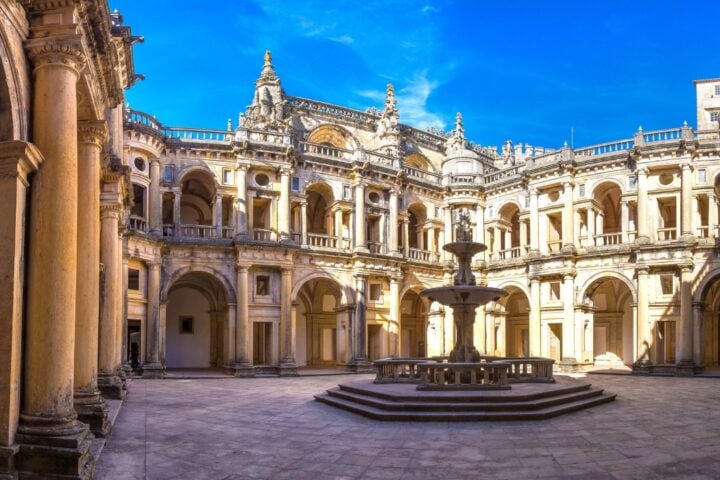
Tomar makes the transition from medieval warfare to maritime ambition unusually clear. The Knights Templar founded their stronghold here in the twelfth century. After their suppression, the Portuguese Order of Christ inherited much of their property and later became closely associated with overseas expansion. Inside the Convent of Christ, the round Charola feels like a building within a building, its painted and gilded surfaces demanding a slower look.
Outside, the famous Manueline chapter-house window tangles ropes, vegetation and maritime imagery into stone. Allow two to three hours for the complex, including its stairs and courtyards. Tomar is around 1 hour 40 minutes to two hours from Lisbon by road. For a day trip, Portugal Magik is a trusted private tour partner in Portugal, using Mercedes-Benz vehicles. A local driver/guide can shape the day around the guests, leaving room for the riverside town rather than squeezing in another distant monument.
Browse our travel inspiration for ideas, or tell us what kind of day you have in mind.
Lisbon and the complicated promise of the ocean
In Belém, the Jerónimos Monastery gives Portugal’s maritime age its most theatrical architectural expression. Construction began in 1501 under Manuel I, in a kingdom growing wealthy through overseas trade and imperial expansion. Look closely at the cloister before turning towards the river. Belém Tower once occupied a more isolated position in the Tagus, guarding an approach to a city increasingly connected to Africa, Asia and Brazil.
The phrase Age of Discovery needs context. These voyages expanded geographical knowledge and commercial networks, but also brought conquest, enslavement and exploitation. The monuments become more meaningful when those histories remain in view. Reserve monastery admission ahead where available and check tower access, since restoration can affect visits. From central Lisbon, allow 20 to 40 minutes by car, longer in heavy traffic. Afterwards, a warm pastel de Belém provides a modest pleasure that requires no historical argument.
Alentejo, where centuries share the same street
Évora rewards visitors who resist treating its Roman temple as a single isolated attraction. Built in the first century AD, it stands beside later religious and aristocratic buildings, with the cathedral a short walk away. The familiar name Temple of Diana is not supported by firm evidence. What matters more is the survival of those granite columns and marble capitals through the city’s many reinventions.
Allow around 1 hour 30 minutes to 1 hour 45 minutes from Lisbon to Évora by road. An overnight stay gives you cooler morning streets and an evening meal of açorda alentejana or black pork. Farther east, Elvas tells a later military story through its extraordinary bastioned fortifications, recognised by UNESCO. It is roughly an hour from Évora. Visit exposed sites early during hot months, and remember that cobbles, gradients and broad fortress grounds make sensible shoes essential.
The Algarve before the beach umbrella
Silves offers one of southern Portugal’s clearest encounters with its Islamic past. Its red sandstone castle crowns a town that was an important urban centre under Muslim rule. The surviving fabric includes later rebuilding, so read it as a layered stronghold rather than an untouched relic. From Faro, allow about 45 to 60 minutes by road, then walk uphill before the afternoon heat.
Lagos adds the darker Atlantic chapter. Its Mercado de Escravos museum addresses the slave trade and the arrival of enslaved Africans in 1444. Continue to Sagres, roughly 35 to 40 minutes away, for the exposed headland and fortress associated with Prince Henry. Avoid imagining a documented navigation school operating here: that familiar story exceeds the evidence. Back in town, grilled fish or a seafood cataplana makes a fitting coastal supper, without needing to turn every meal into a lesson.
Beyond the mainland, the Atlantic archive
Madeira and the Azores belong within this history, not in a footnote. In Funchal, the cathedral’s remarkable wooden ceiling recalls the wealth of early colonial Madeira. Sugar cultivation helped shape the island’s economy, alongside enslaved labour and expanding Atlantic trade. Pair the cathedral with the Museum of Sacred Art, whose Flemish works reveal connections reaching well beyond Portugal.
On Terceira, Angra do Heroísmo preserves the urban legacy of a crucial Atlantic port, where ships travelling between continents found shelter and supplies. Walk its streets, then look back across the bay from Monte Brasil. Reaching either archipelago requires a flight, not an ambitious mainland detour. Give Madeira or Terceira at least three nights. Across Portugal, history is most rewarding when the itinerary leaves space to notice what survived, what changed and whose stories are still being recovered.
Plan your own day
Share your dates, group size and interests, and we will suggest a tailored plan with a local driver/guide.